
Oil Prices Surge Past $100 - What This Means For Investors
The war in Iran has spiked oil prices to over triple digits, reminiscent of 2022’s Russia-Ukraine crisis. However, the macroeconomic backdrop is far different this time…
Why Oil Prices Are Spiking
The Strait or Hormuz is the narrow waterway, bordered to by Iran to the north, and the Gulf states (Qatar, UAE, Saudi Arabia, etc.) to the south. This tiny strait has become the global energy chokepoint.
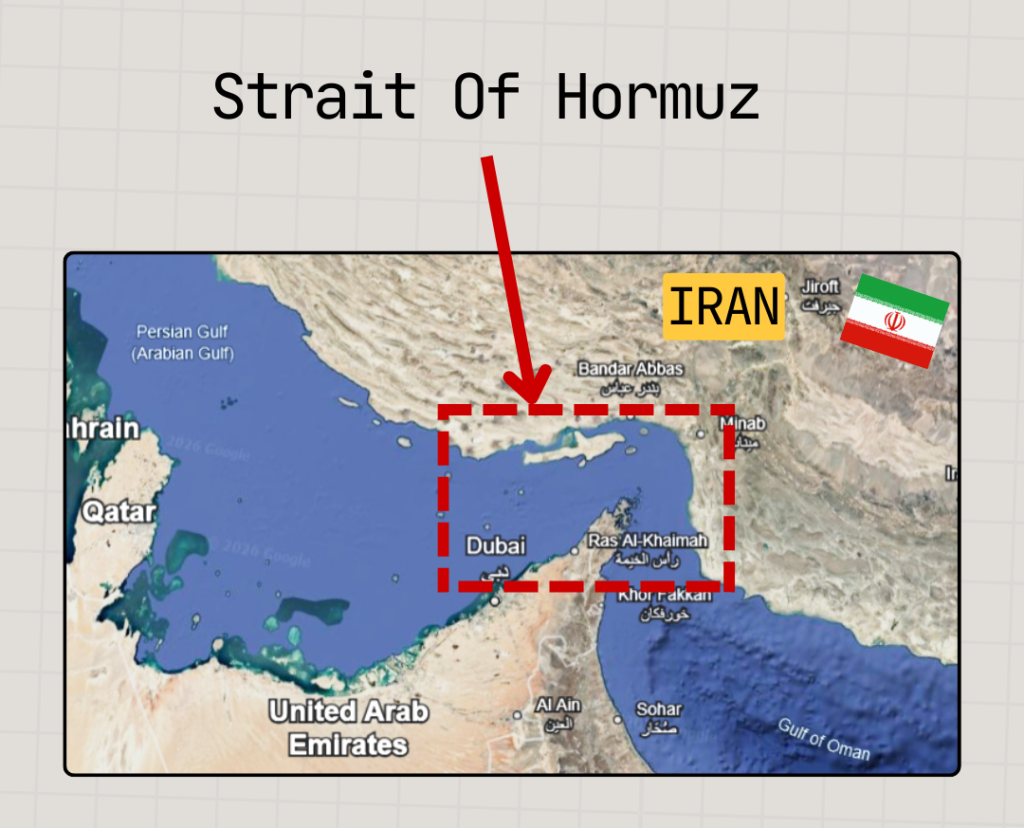
Approximately 20% of all the world’s oil exports pass through this tiny strait. Iran has threatened to fire on any vessels passing through the strait. It appears that the Iranian regime is perfectly content with constricting oil supply, as this exerts pressure on the US administration.
Non-military vessel traffic across the Strait of Hormuz has virtually collapsed in the few days since this war started.
To Make Things Worse...
Beyond the strait closure, Saudi Arabia’s Aramco (the world’s largest oil company) has also announced production cuts at two oil fields, while Qatar, the world’s largest liquified natural gas (LNG) exporter, also shut down its gas liquefaction operations 5 days ago.
To the dismay of the renewables crowd, the world energy mix is still dominated by-oil, coal, and natural gas.
Therein lies the problem – spiking oil/energy prices affect virtually every other area of production, often causing inflation to surge.
Is 2022 Repeating All Over Again?
“History never repeats itself, but it often rhymes” ~ Mark Twain.
Today’s debacle certainly echoes similarities to what happened in 2022 – war, oil price spike, so is runaway 9% inflation coming again?
Maybe not. While elevated oil prices unquestionably flash danger signs of inflation. It’s also worth noting that the macroeconomic context is far different now than it was in 2022:
| Parameter | February2022 | March 2026 (today) |
|---|---|---|
| Parties | Russia-Ukraine | US/Israel-Iran |
| US Interest Rates | Lower ~0.1% | Higher ~3.6% |
| US Unemployment Rate | 3.9% and FALLING | 4.4% and RISING |
| US Inflation Rate (CPI) | ~5% | ~2.4% |
Most notably, in 2022, the economy was screaming full-steam ahead out of Covid and massive stimulus. Demand-pull inflation was already running up before Russia-Ukraine spiked oil prices.
This time though, the backdrop is one of rising unemployment, and relatively manageable existing inflation rates.
The Fed's Job Just Got Harder
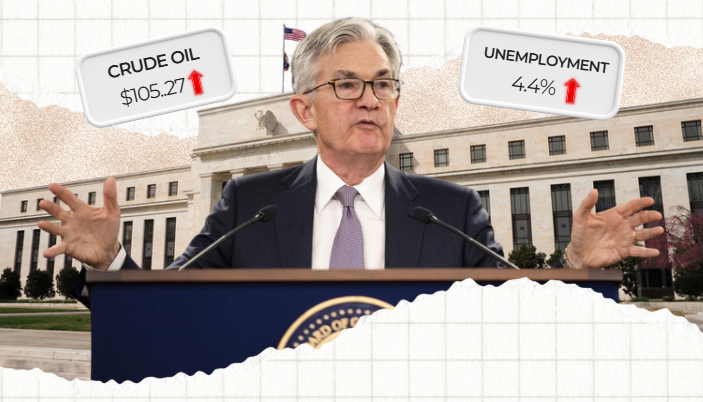
Prior to the war, the focus was clear – with inflation falling and unemployment rising, the Fed just had to keep lowering rates gradually to achieve the desired “soft landing” (slowing the economy down from 2022’s inflation spike without causing a recession).
But this war has now tossed the Fed a curveball. If oil prices stay elevated, any rational forward-looking person would expect inflation to tick up again. Against inflation, the Fed just has to raise rates as it did in 2022. But that’s the thing…this IS NOT 2022 – in 2022 unemployment was falling and demand was strong. In 2026 (today), unemployment is rising.
The unemployment rate currently sits at 4%, but last Friday’s jobs data was worrying – non-farm payrolls came in at -92K (net loss), against expectations of +59k (net gain). Evidently, unemployment remains the foremost threat.
Yet, if oil prices don’t see relief soon, the Fed is likely to find itself between a rock and a hard place. If it lowers rates to fight unemployment, inflation may heat up again. If it seeks to fight inflation, unemployment may continue to rise, eventually leading to a recession.
How I'm Positioned
No, I’m not FOMO-ing into oil stocks or defense stocks to try to ride the current wave.
I’m fairly happy holding my positions as is – for the main part, I had trimmed my positions in most consumer-facing and tech stocks prior to the war starting, and now mainly hold B2B and B2G contractors.
This was not made in prediction of the war, but I have noticed that my holdings have been nearly unaffected by the market’s recent correction. I’d attribute this to the fact that contract businesses (especially government contractors) are not fundamentally shaken by recessions or geopolitical events as much – perhaps even more so than the “defensive” stocks.
I have also opened a short position on bitcoin.
Therefore, my portfolio is currently short-risk, long-contractors, with substantial spare cash ready for any attractive opportunities.
This does not constitute any form of investment advice or recommendations.